Protect your foundation
Reduce the risk of overexposure by separating the business into clearer, more defensible layers.
The defensive blueprint for serious digital founders
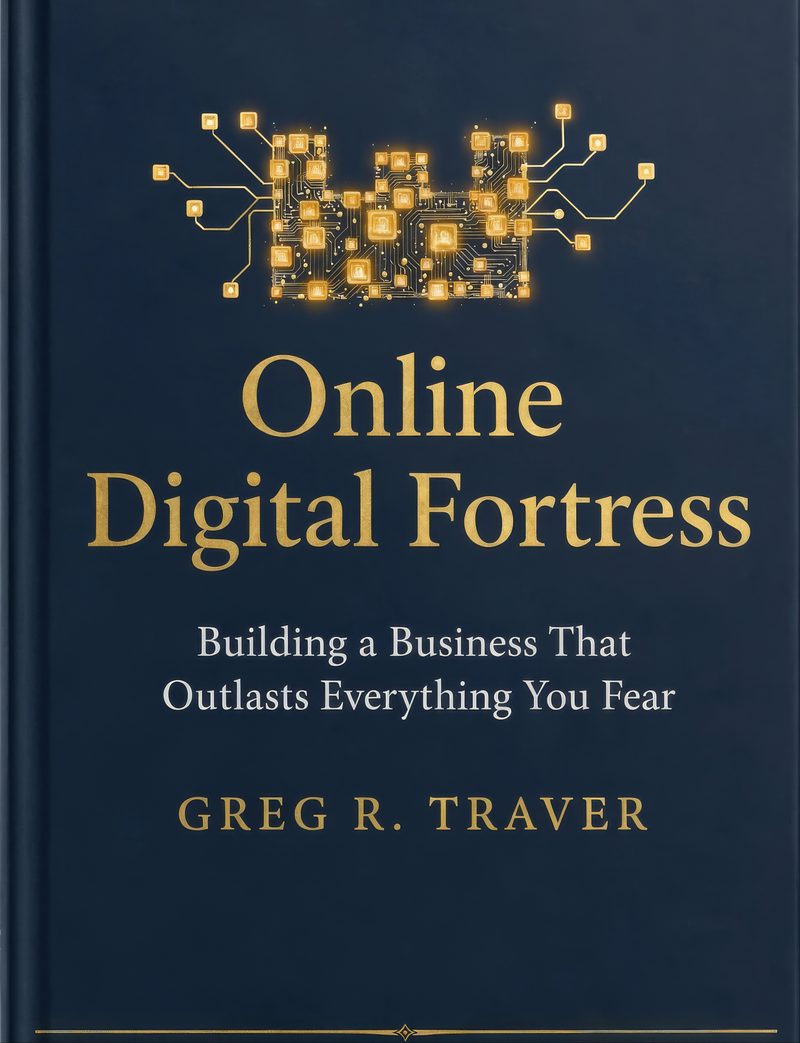
Online Digital Fortress shows digital creators how to separate revenue, operations, and intellectual property into a structure designed for protection, lawful growth, and long-horizon legacy.
The diagnosis
Simplicity without separation is not strength. If customer risk, contractor risk, platform risk, and intellectual property all sit together, one problem can crash it all.
When revenue, operations, and intellectual property are crowded into one shell, one dispute can reach far more than it should.
More customers, contractors, and transactions do not reduce exposure. They intensify the cost of weak architecture.
A business designed only for today's sales is rarely ready for licensing, succession, or a clean eventual exit.
The Triple Shield Architecture™
The Triple Shield Architecture is memorable because it gives each layer a clear job. One layer generates revenue, one governs operations, and one preserves what should endure. The result is a business built with cleaner lines of responsibility and stronger long-term logic.
The creator layer handles offers, customers, and market-facing activity without becoming the permanent home of everything valuable.
The management layer governs people, vendors, systems, and administrative order so operational friction does not spread everywhere.
The holding layer is where intellectual property, long-horizon value, and the foundations of legacy are meant to be protected.
Who this is for
No storefront. No office. No physical presence in any state. If every sale you make happens online, and you already have something worth protecting, the Triple Shield Architecture™ was designed for exactly your kind of business.
If you sell any of these online, this is for you:
About the book
Peace through structure is the real promise behind the message.
The core argument is simple and severe. Many digital businesses look successful on the surface while remaining structurally fragile underneath. The book reframes entity design, compliance, financial systems, licensing, scaling, and exit planning as parts of one integrated doctrine rather than disconnected administrative tasks.
belongs in the creator layer instead of carrying every other burden with it.
need their own disciplined system of management, documentation, and accountability.
should be preserved like an asset, not left exposed inside operational turbulence.
Why this doctrine matters
Online Digital Fortress did not begin as a marketing concept or a repackaging of familiar business advice. It emerged from Greg Traver's search for the most secure, strategically sound, and resilient way to protect digital assets, intellectual property, revenue, control, and long-term freedom in an increasingly exposed online economy.
What he uncovered was not a slogan, but a doctrine: a disciplined framework for separating creation, management, and ownership so a business can grow with clearer boundaries, stronger protection, lawful monetization, and greater permanence. It was built in response to a problem that many entrepreneurs do not fully recognize until growth, conflict, or loss makes the weakness impossible to ignore.
That is what gives Online Digital Fortress its force. While much of the business world teaches speed, visibility, and scale, this work speaks to something deeper and more enduring: defensibility, structure, and legacy. It challenges founders to think beyond immediate revenue and build enterprises capable of surviving pressure, protecting value, and standing the test of time.
This is why the book carries unusual potential. It is not simply a guide to doing business better. It is a new way of seeing the architecture of digital business itself. For the right reader, Online Digital Fortress will not feel like another business book. It will feel like a shift in perspective.
Why this carries weight
The book emerged from a clear recognition: many digital businesses appear strong on the surface while remaining structurally fragile underneath. The goal is not to create fear. The goal is to create clarity, protection, and a more durable way to build.
What you will gain
What this helps you do
Reduce the risk of overexposure by separating the business into clearer, more defensible layers.
Create stronger systems for contracts, access, documentation, and operational control.
Prepare for licensing, continuation, transfer, and long-horizon value instead of reacting too late.
Start here
The audit is the fastest way to see the structure of your business clearly and identify where protection, separation, and control may need to be strengthened.
Free resource
Enter your full name and email address and you'll get instant access to download the complete Digital Fortress Self-Audit.